
Innovation of artificial intelligence applied to the analysis of medical images in senology and interventional cardiology

Xavier Lessage is a researcher in the Data Science department at CETIC. His main interests are artificial intelligence, cloud computing and distributed data processing (high performance computing).  One of his main areas of interest is health and more specifically, the use of artificial intelligence in health care.

The major axes of his work concern breast cancer and interventional cardiology using traditional and federated architectures. His research consists, on the one hand of evaluating Deep learning algorithms (binary classification, anomaly localisation, explicability, etc.) in the field of medical imaging with private databases (retrospective study). On the other hand, to validate the models retained in hospitals but on new images (prospective study) with the aim of analysing the behaviour of the AI in real situations.

By helping to reduce the cost and workload of doctors by combining two intelligences: the first, artificial, to make an initial analysis and the second, human, to interpret the results and make the right diagnosis. In the context of breast cancer in particular, the interpretation of a mammographic image is a difficult task and requires verification by a second reader, or even a third (in the event of discrepancies) in order to reduce the number of false negatives. The role of the second reader could be taken over by an AI, leaving time for the second reader to perform other tasks, such as that of the first reader.

To learn more about his current projects or publications : https://cutt.ly/gOigulY
An artificial intelligence learns with me how to find the causes of genetic diseases in scientific articles

Passionate about the secret behind genetic diseases, Charlotte Nachtegael, after obtaining a master’s degree in biomedical sciences at UMONS, began a master and then PhD in Bioinformatics on the study of complex genetic disorders at the (IB)2 (Interuniversity Institute in Bioinformatics in Brussels) and at the MLG (Machine Learning Group) at ULB.

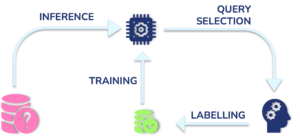
Her work consisted first to find in the scientific literature combinations of mutations causing complex genetic diseases, gathered in a database (publication currently under review). This enormous biocuration effort encouraged her to focus on text mining techniques to be able to automatically extract this data from the text and make it easily available. She is also using the principle of active learning, directly involving the human expert in the development of the artificial intelligence.

This automatic extraction of data on complex genetic disorders should bring an advantage to the medical and bioinformatic fields, moreover with the increase of genetic data and the related publications on the subject. This data can be used afterwards to study the causes of rare genetic diseases or to develop prediction tools during pregnancy… Additionally, this opens a direct interaction between human and artificial intelligence with the use of active learning, where the human teaches directly to the model. This work should then, we hope, increase the trust towards artificial intelligence.


When artificial intelligence meets image compression, privacy-friendly video surveillance becomes possible

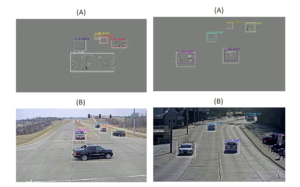
–During the first edition of the TRAIL workshop in September 2020, Karim El Khoury and Jonathan Samelson, started implementing a framework to provide a public and privacy-friendly image representation for video traffic analysis. The goal was to utilize the inexpensive and privacy-friendly compressed domain residual frames for efficient vehicle tracking. In November 2021, their work was published in the Frontiers in Signal Processing Journal as part of a special issue on Deep Learning for Video Surveillance. The publication is accessible via https://doi.org/10.3389/frsip.2021.765006
–According to Karim El Khoury and Jonathan Samelson, the main issue with big data, and more specifically video surveillance data, is privacy. By proposing the use of compressed domain residual frames as an image representation for deep learning-based object tracking, their AI solution priorities the right of people’s privacy while maintaining efficient performance.
Experimental results of vehicle detection and tracking on privacy-friendly compressed domain residual images (A) versus intrusive decoded images (B)